The Directorate of the Advertising Regulatory Board (ARB) has instructed Unilever to amend the claim, “100% plant-based actives” on the front of the packaging of its Sunlight Platinum dishwashing liquid.
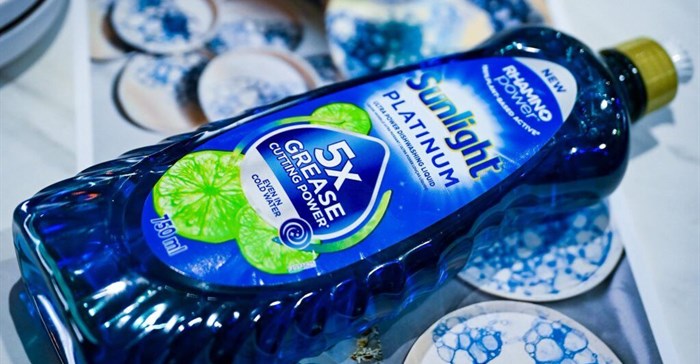
The ARB has instructed Unilever to amend the claim appearing on the front of its Sunlight Platinum packaging stating “100% plant-based active” (Image source @ Mzansi Pulse
Mzansi PulseThis follows a complaint that while the front of the packaging states “100% plant-based actives,” on the back, in small print, it states “other non-plant-based actives are included”.
The Complainant essentially argues that if other non-plant-based actives are included, then the product canʼt contain 100% plant-based actives.
The Complainant further notes that the back label states that the product causes skin irritation and serious eye damage ‒ not that it “can” or “may” cause these outcomes ‒ and recommends that users wear face protection and gloves.
The Complainant points out that this is not a usual requirement for doing the dishes.
Sunlight’s response
Sunlight responds that the claim made on the packaging is intended to communicate the presence of rhamnolipids as a key surfactant ingredient included in the product.
Rhamnolipids are produced from sugar and are 100% natural, manufactured by biological fermentation processes that are not derived from petrochemicals, that is meaning the ingredient is 100% plant- based.
Unilever says the disclaimer on the product back label, “#Rhamnolipids. Other non-plant-based actives are included”, is intended to make clear to consumers that, in addition to the 100% plant-based rhamnolipids, the product also contains other non-plant-based actives.
Unilever also provided documentary evidence, which it says “objectively supports the claim in respect of the product”.
The evidence, it said, has been independently verified by Professor Anwar Jardine, an associate professor and current research scientist and head of the department of chemistry at the University of Cape Town.
His findings confirm that “Rhamnolipids are 100% plant based, renewable and biodegradable. It is also ultra-mild on skin, which sets it apart from other surfactant options”.
It is therefore submitted that the claim is communicated transparently and honestly to consumers, is fully substantiated, and is not misleading to consumers.
GHS international framework
About the warning statement on the back of the product bottle, the Advertiser stated that it emanates from the “Globally Harmonised System of Classification and Labelling of Chemicals (“GHS”), which is an internationally recognised, science-based framework designed to ensure consistent identification and communication of chemical hazards worldwide.
In South Africa, the use of GHS labelling is a compulsory regulatory requirement under the Hazardous Chemical Agents Regulations, administered by the Department of Employment and Labour.
The inclusion of the GHS hazard information does not indicate that the product is unsafe when used as intended, but rather ensures that potential hazards are communicated transparently.
However, when the product is used as directed, the level of exposure to the consumer is significantly reduced.
Application of the Code of Advertising Practice
The following clauses were considered in this matter:
- Clause 2 of Section II ‒ Honesty and responsibility
- Clause 4.1 of Section II ‒ Truthful presentation: Substantiation
- Clause 4.2.1 of Section II ‒ Misleading claims
- Clause 2.1 of Appendix G Advertising containing environmental claims ‒ Absolute claims and statements.
At the outset, the Directorate notes that the warnings printed on the label are dictated by regulation and, as such, do not fall within the jurisdiction of the ARB.
The only issue that the Directorate can consider is the claim “100% plant based active”.
While the Directorate accepts that the rhamnolipid ingredient is 100% plant based, it notes this is not what was disputed.
The issue before the Directorate is, in fact, whether the claim “100% plant based active” leads the consumer to believe:
- That one of the active ingredients is plant-based, but there are other active ingredients (which appears to be the situation).
- That the only active ingredient is plant-based, although there may be other non-plant-based ingredients.
- That all the ingredients are plant-based.
While the Directorate accepts that Rhamno powder is 100% plant-based, it has some concerns about the claim and its positioning on the product bottle.
In selecting a product off the shelf, if a consumer were to see the wording “100% plant based active”, the Directorate believes that they could reasonably assume that the whole product is 100% plant-based or that the only active ingredient is plant-based, not that there is only one ingredient that happens to be derived from plants and many other active ingredients.
Ambiguous wording
The Directorate further notes that the word “active” may be taken to mean “active ingredient”, but it could also be an adjective (descriptive term) about the “action” of the product, making it unclear to the consumer what is actually being conveyed by the packaging.
In addition, the “headline” nature of the claim leads the consumer to believe that this claim is pivotal to the nature of the product, which lends support to the idea that this is the only active ingredient.
The wording is, at best, ambiguous. It could reasonably communicate any of the three interpretations listed above, only one of which would be correct.
It appears that the more accurate claim would be “made with 100% plant based Rhamno powder”.
Not sufficient to avoid confusion
The Advertiser points out that it states “other non-plant-based actives are included” on the back of the packaging.
The Directorate does not accept that this is sufficient to avoid confusion.
Simply put, it is not permissible to make a statement that is confusing at best, and misleading at worst, on the front of a product, and then clarify on the back of the product that this is not the only active ingredient.
Finally, the Directorate notes that plant-based claims carry weight with consumers, who are often eager to reduce their use of chemicals for health or environmental reasons.
Indeed, there is no doubt for this reason that the Advertiser has “headlined” this one active ingredient.
This is, in effect, a type of greenwashing.
This being the case, the Directorate finds that the claim on the front of the product packaging is misleading and in breach of Clauses 2 and 4.2.1 of Section II.
Unilever is instructed to amend the claim appearing on the front of the packaging: “100% plant-based active”, without further context or clarity, within three months, as required by the Procedural Guide.















![Image credit: [https://kaboompics.com/photo/42026/blue-plastic-sheet-abstract-texture-vertical-composition Kaboompics]]](https://biz-file.com/c/2610/824275-300x156.jpg?5)


