I have just returned from the Africa Food Systems Forum in Kigali, Rwanda - the 20th anniversary of a gathering that began as a small agricultural conference and has grown into the continent's most important annual meeting point for policymakers, financiers, farmers, and food-system practitioners.
This year's theme, "Investing in Africa's Agri-Food Systems: Nourishing Nations, Growing Jobs, Building Resilience," could not have been more fitting. Every conversation I had in Kigali, whether in a plenary hall or over a coffee between sessions, kept circling back to the same uncomfortable truth: we know what needs to be done, we know roughly what it costs, and yet the investment keeps arriving too late, too little, and too reactively. I left with a clear conviction that what we invest in food systems now is what determines how vulnerable the people on our continent will be in the future.
A continent that grows food but cannot feed itself
The numbers presented in Kigali, some drawn from the newly released State of Food Security and Nutrition in the World report, are sobering. For the first time on record, Africa now has more hungry people than Asia - roughly 309 million people faced hunger in 2025, compared with 292 million across the whole of Asia, a continent with more than three times our population.
Around one in five Africans go hungry, and two-thirds of the population cannot afford a diet that meets basic nutritional needs. That statistic has barely moved in a decade, even as the rest of the world posts modest gains. Africa holds an enormous share of the planet's arable land, its freshwater reserves, and its youthful agricultural workforce. We are, by any resource-based measure, the continent best positioned to feed itself and a good part of the world. And yet we carry the heaviest burden of food insecurity on earth.
That contradiction is the outcome of decades of underinvestment in the systems that turn raw agricultural potential into food that reaches a plate - roads, cold storage, irrigation, market infrastructure, processing capacity, and the logistics that connect a harvest to a household.
Crisis management is not a long-term strategy
One thread ran through almost every session I attended in Kigali: Africa's investment cycle is dictated by crisis, not by long term planning. A drought hits the Horn of Africa, and the world mobilises emergency funding. A conflict displaces millions, and humanitarian budgets are redirected overnight. Aid cuts announced elsewhere ripple through nutrition programmes on our continent within months. We lurch from emergency to emergency, and every time we do, the money that should have gone into long-term resilience - irrigation schemes, storage facilities, early warning systems, seed banks - gets deferred yet again in favour of the immediate crisis in front of us.
This is an expensive way to implement a food system, and certainly not sustainable. Emergency response is always more costly per person helped than prevention. Breaking this cycle must be a founding principle of how we now approach food security on this continent.
That means getting serious about prediction. Climate scientists, agronomists and food-security analysts already have the tools to see many shocks coming - a poor rainy season, a pest outbreak, a price spike in imported grain- months before they become emergencies. The technology exists. What is missing is the political and financial will to act on early warning signals before they become headlines. Investing in foresight is one of the highest-return decisions available to us, and it was encouraging to hear it treated as a serious agenda item in Kigali.
The quiet crisis behind the visible one
If there was a single word that recurred more than any other across the Forum's sessions, it was "infrastructure." Cold chains; rural roads; storage; processing capacity; irrigation; and surplus food recovery solutions. Post-harvest loss across parts of the continent remains alarmingly high, and much of it is entirely preventable with the right storage, transport, and cold-chain infrastructure. Closing this infrastructure gap has to be treated as a core food-security investment, not a secondary agricultural development issue.
Lessons learned
Engaging in the various sessions allowed me to reflect on the work we do here at FoodForward SA. Since being established in 2009, we have been guided by a simple but powerful idea: instead of treating surplus food as a disposal problem, treat it as a resource that can nourish people. Over the years, we have turned that idea into action, building the largest food redistribution network on the African continent. Today, our vetted and monitored national network comprises more than 2,200 beneficiary organisations, reaching close to one million vulnerable South Africans every day across all nine provinces.
Every ton of food we recover from farmers, manufacturers and retailers is a ton that does not need to be grown, processed or transported again to meet the same need, and a ton of food that does not end up rotting in a landfill emitting methane.
More importantly, South Africa is moving toward a full ban on sending organic waste to landfill, starting in the Western Cape in 2027 and expected to spread nationally. Roughly a third of all food produced in this country is currently wasted, and a large share of what reaches landfill is still perfectly edible. That is a moral failure and a compliance and cost problem for every food business in the food value chain.
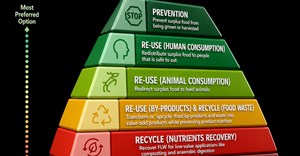
This is where the opportunity lies. As organic waste bans come into force, businesses need diversion programmes - practical pathways for surplus food to leave the supply chain before it becomes waste. Food banking should sit at the very top of that diversion hierarchy, ahead of composting or anaerobic digestion, because it captures the nutritional value of food before it captures only its fertiliser value.
A donated crate of vegetables feeds a family; a composted crate of vegetables enriches soil. Both have value, but only one addresses food insecurity. Getting the right food to the right place, quickly, is now as much a climate strategy as it is a food security strategy.
The impacts of getting this right extend well beyond any one balance sheet. For nature, it means less pressure to convert new land for farming, because we are wasting less of what we already grow, and less methane escaping from landfills. For the climate, it means a measurably smaller footprint per meal delivered. And for the consumer - the mother deciding what she can afford to put on the table tonight- it means the possibility, eventually, of a healthy diet that isn't out of her reach.
I left Kigali energised, because I watched rooms full of serious people farmers, financiers, scientists, civil servants, and fellow food-bankers from across the continent refuse to accept that abundance and hunger have to coexist on the same soil.