Scientists at the University of Cape Town (UCT) called for heightened monitoring of the Karoo Basin after uncovering evidence of a previously unknown fault that could trigger earthquakes in a region the government has earmarked for shale gas exploration.
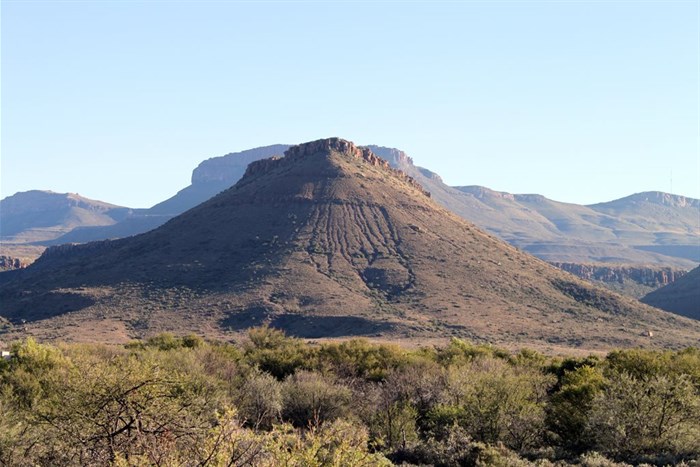
Hill in siliciclastic strata (mud or siltstones capped by solid sandstone) of Teekloof or Abrahamskraal formation (Beaufort Group) of the main Karoo Basin. Image credit:
flowcomm,
CC BY 2.0, via Wikimedia Commons
Scientists at UCT’s Department of Geological Sciences said their findings suggest that geological conditions associated with induced seismicity in other shale gas regions worldwide may also exist beneath parts of the Karoo, according to a statement.
Their study examined an “earthquake swarm” near Leeu Gamka, Western Cape province, that began in 2007 in an area previously considered relatively quiet seismically, but has since recorded at least 66 earthquakes, including one with a magnitude of 4.8 on the Richter scale.
Lead author Benjamin Whitehead said the study showed critically stressed faults are already present beneath parts of the Karoo.
“Our study shows that critically stressed faults are already present beneath parts of the Karoo.
“These structures are capable of generating earthquakes under the current stress regime, which means they should be carefully identified and monitored before any future shale gas development,” said Whitehead.
Earthquakes observed in the Karoo were natural and not caused by hydraulic fracturing, he said, although global experience showed that wastewater injection and shale gas operations can reactivate pre-existing faults under certain conditions.
Whitehead said the findings should not halt shale gas development but rather inform future decisions by helping identify areas where extra precautions may be needed.
The Petroleum Agency of South Africa (PASA) estimates the Karoo Basin holds around 209 trillion cubic feet (tcf) of technically recoverable shale gas resources, although a 2017 study by geologists at the University of Johannesburg estimated this at 13 tcf, at the lower end of estimates ranging from 13 tcf to 390 tcf.