South Africa's road freight industry has called for urgent reforms, stronger partnerships and improved logistics performance to address mounting operational pressures and support economic growth.
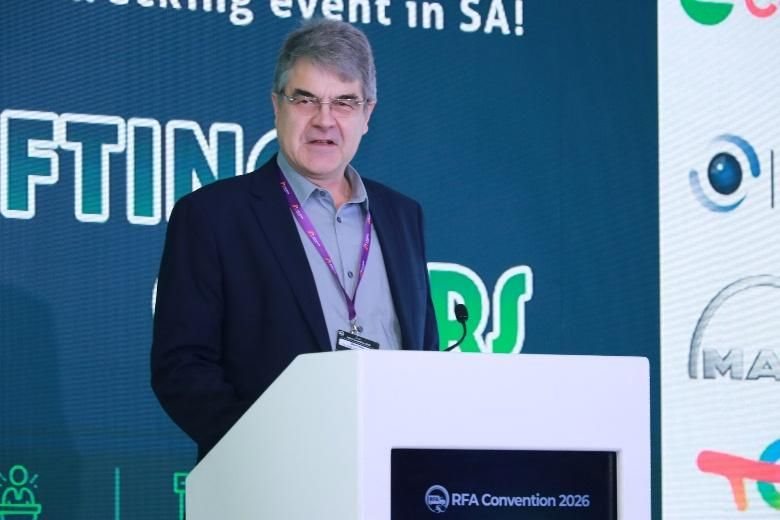
Source: Supplied | RFA CEO Gavin Kelly
The message emerged from the Road Freight Association's (RFA) 2026 Convention, which took place from 29-31 May 2026, where industry leaders, government representatives and transport stakeholders highlighted challenges ranging from rising diesel costs and infrastructure constraints to crime, labour pressures and supply chain inefficiencies.
Industry faces mounting cost pressures
RFA chairperson Penwell Lunga said diesel prices had risen by more than 60% this year, placing significant pressure on operators.
“With diesel accounting for more than 40% of operating costs for many operators, the current cost environment has become unsustainable and unlike anything the industry has experienced before,” he said.
RFA CEO Gavin Kelly highlighted several achievements during the past year, including 14% membership growth, another year of labour peace and continued industry engagement.
However, he said operators continued to face significant challenges.
“As an industry, we faced serious pressure regarding undocumented foreign drivers, port queues, terminal congestion, rail performance decline, increased crime, shrinking margins – and much more besides. These challenges require active participation from every member, stronger compliance, better data, smarter technology and practical collaboration across the sector.”
Kelly also pointed to risks linked to employment equity implementation, B-BBEE uncertainty, violent protests, crime, labour militancy and fleet immobilisation, while identifying opportunities associated with the African Continental Free Trade Area (AfCFTA), freight cities and increased private sector participation in ports and rail.
Government highlights transport reforms
Deputy Minister of Transport Mkhuleko Hlengwa told delegates that government remained committed to developing a sustainable and integrated freight sector.
“An efficient and functioning transport sector that moves people and goods safely, speedily and affordably across the length and breadth of our country is the key to a successful economy,” he stated.
He said government would continue supporting rail reforms, road maintenance, port efficiency improvements, border management upgrades, overload control, truck stop infrastructure, driver wellness initiatives and corridor security.
“Policy alone will not deliver reform. Partnership with industry and labour is essential,” he stressed.
Experts outline industry priorities
Several speakers addressed the economic, political and operational issues shaping the transport sector.
Simphiwe Letlojane, Head of Security Investments at Absa, linked freight performance to factors including geopolitics, oil prices, inflation, interest rates, Transnet reforms and infrastructure investment.
“Transnet has improved its performance,” he noted, while highlighting improvements in logistics, port and rail indicators.
Political analyst Justice Malala examined domestic and global risks, including coalition politics, immigration tensions, local government elections, geopolitical conflict, climate change and artificial intelligence.
“There’s no such thing as bad weather, only bad clothes,” he said, urging businesses to prepare for uncertainty and remain adaptable.
Sustainability and labour remain in focus
Liesl de Wet, chairperson of the RFA Green Transport Working Group, said sustainability was increasingly becoming a business resilience issue.
“You can’t manage what you don’t measure,” she said, encouraging operators to improve efficiency through telematics, route planning, predictive maintenance, loading optimisation and alternative fuel readiness.
Magretia Brown-Engelbrecht, director at the ADR Hub, focused on wage negotiations in the road freight and logistics sector, calling for a modernised collective bargaining framework.
“Collective bargaining is evolving, and so must we,” she said.
The convention concluded with a call for greater industry participation, collaboration and engagement as the sector navigates a changing operating environment.