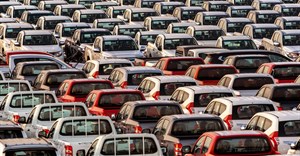
South Africa’s new vehicle market recorded another month of double-digit growth in September, with domestic sales rising 12.7% year on year despite continued pressure from inflation, borrowing costs and weak export demand.
A total of 61,645 new vehicles were sold locally during the month, up from 54,706 in September 2025, according to Naamsa.
The growth was driven primarily by passenger cars, with sales increasing 14.7% to 44,291 units from 38,615 a year earlier. The car rental industry accounted for 18.4% of passenger vehicle sales during the month.
Sales of new light commercial vehicles, bakkies and minibuses also increased, rising 9.6% to 14,361 units.
Medium commercial vehicle sales grew 3.4% to 789 units, while the heavy truck and bus market declined slightly to 2,204 units from 2,229.
The domestic market's performance contrasts sharply with export activity. Vehicle exports fell 18.8% year on year to 31,473 units in September.
Of the 61,645 vehicles sold domestically, dealer sales accounted for an estimated 81.4%, followed by the rental industry at 13.8%, government at 2.6% and corporate fleets at 2.2%.
Naamsa CEO Mncane Mthunzi said the market had demonstrated resilience despite higher borrowing costs, renewed inflationary pressures and subdued economic growth.
NEV sales continue to accelerate
South Africa’s new energy vehicle (NEV) market is also continuing to expand, with cumulative sales reaching 18,945 units in the first eight months of 2026.
That figure has already surpassed the 16,703 NEVs sold during the whole of 2025.
Hybrid electric vehicles accounted for 49.6% of NEV sales during the first eight months of the year, followed by plug-in hybrids at 36.5% and battery electric vehicles at 13.8%.
Plug-in hybrid and battery electric vehicle sales have grown particularly quickly. PHEV sales reached 6,919 units by August, compared with 2,810 for the whole of 2025, while BEV sales stood at 2,622 units against 1,088 during 2025.
Naamsa said the growth of rechargeable vehicles, which now account for more than half of NEV sales, points to a shift towards more heavily electrified powertrains.
The association also noted early adoption of electrified vehicles in the light and medium commercial vehicle segments, although volumes remain relatively small.
It said continued NEV growth would depend on factors including charging infrastructure, electricity costs, vehicle availability and the localisation of NEV and component manufacturing.
The September sales figures come as South Africa’s manufacturing sector showed some signs of improvement. The seasonally adjusted Absa Purchasing Managers’ Index rose above the 50-point mark in September after three consecutive months in contraction.
Naamsa said the combination of stronger vehicle sales and an improving PMI provided an encouraging indication of underlying economic activity, although it was too early to conclude that a sustained manufacturing recovery was under way.