A new study showed that a Labrador retriever that was trained to sniff out cancer was able to detect colon cancer nearly as accurately as a colonoscopy.
(Image: Wikimedia Commons)
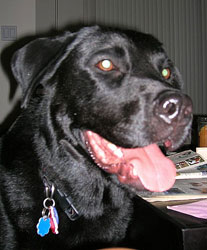
For the study the researchers at Kyushu University trained an 8-year-old female Labrador retriever named Marine who was given breath and stool samples of 306 patients, collected right before they received colonoscopies. 48 patients had recently been diagnosed with bowel cancer, and the other 258 were either suffering from another colorectal ailment or had survived cancer, or were healthy. In her assessment, Marine was at least 95% as accurate at identifying cancer as colonoscopy, and 98% correct when sniffing stool samples, the researchers found. She could best spot early stage cancer, and could discern polyps from malignancies, which even colonoscopies can not do. The study was published today in the medical journal Gut.
Early detection the 'holy grail'
Trevor Lockett, a bowel cancer researcher with the Commonwealth Scientific and Industrial Research Organisation in Australia said, "Detection of early-stage cancers is the real holy grail in bowel cancer diagnosis because surgery can cure up to 90% of patients who present with early-stage disease." Although dogs could not be used for this purpose, researchers believe that electronic smell detectors could be developed based on this principle. "This study shows that a specific cancer smell does indeed exist," the researchers wrote adding, "These odour materials may become effective tools in screening."
According to lead researcher Dr. Hideto Sonoda, from the department of surgery at the Postgraduate School of Medicine at Kyushu University in Fukuoka, the study aimed to find out whether odour can become an effective tool in colorectal cancer screening. Speaking of other cancers like breast, stomach and prostate cancer, Sonoda said, "Canine scent judgment yielded correct answers for these cancers as well, suggesting that common scents may exist among various cancer types."
Detection of chemicals
Commenting on the study, Dr. Ted Gansler, director of medical content at the American Cancer Society, said that "this study adds to a small number of other published articles showing similar results regarding bladder, lung and breast cancers," and to a recent conference presentation regarding prostate cancer. The next step is to discover the specific chemicals associated with colon cancer, or with other types of cancers, Gansler said adding that, "Once that is done, scientists will try to develop laboratory tests that detect these chemicals as potential methods for cancer screening."
Dr. Floriano Marchetti, an assistant professor of clinical surgery and director of the Colon and Rectal Surgery Residency Program at the University of Miami Miller School of Medicine, said that "the direction should be to stimulate research in finding the organic compound that the dog reacts to."


