


Trending


Subscribe & Follow
Advertise your job vacancies
Jobs
- Marketing Specialist Sandton
- Production Accountant Cape Town
- Book Binding Supervisor Johannesburg
- Data Engineer George
- Account Manager Marketing George
- Actuarial Pricing Analyst Cape Town
- Reserving Actuarial Analyst Cape Town
- Community & Experience Manager Cape Town
- Project Manager ( Beauty + Ecomm) Remote within South Africa
- Senior Project Manager ( Beauty + Ecomm) Remote within South Africa
Twingo RS tuned to twinkle
29 Jul 2009

Somewhere at Renault's head office a monsieur with high octane in his veins and a twinkle in his eye decided to have some fun - so he took the rather sedate little Twingo city car, fed it a healthy dose of go-fast medicine, dressed it up in a naughty little devil costume and said: “Go and play”.
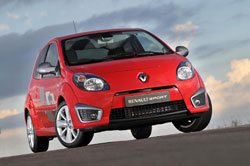
And what a delightful little plaything this jazzed up Twingo is now that it's had a performance upgrade.
Called the Twingo RS (the RS stands for Renault Sport), it joins its hot-blooded sisters the Renault Clio Sport and the Renault Megane Sport.
The Twingo made its first appearance in South Africa a while ago in gentle commuter guise with a small 1.2-litre coffee mill engine that chugs out 56kW and 59Nm.
The fun-injected Renault Sport version, on the other hand, is equipped with a considerably healthier 1.6-litre engine that kicks out an enthusiastic 98kW and 160Nm.
Converted into non-anorak language, this means that for a teeny tot this size it goes like the clappers.
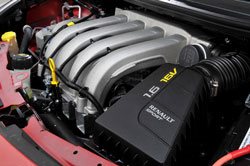
The heart of the Twingo RS is a highly tuned, twin-cam 16-valve engine that thrives on revs. Push it beyond 4,500rpm and it literally snarls into life.
The hot little hatch will sprint from zero to 100km/h in about 8.7 seconds and will only gallop on gamely just past the 200km/h mark.
Yet, in spite of its zippy performance, Renault's official fuel and emission figures are surprisingly low at 7.0-litres/100km, and 165g/km.
Power is transmitted to the front wheels via a short-shift five speed manual box and part of the fun of flicking through the gears is a nice and naughty growl-and-crackle exhaust note, courtesy of a special four-into-one exhaust system.
I recently spent a week scooting around in the hotted-up Twingo and had great fun, particularly on stretches of deserted country road blessed with a lovely mix of straight stretches, long fast bends and a couple of tight corners.
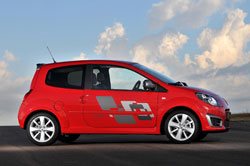
Besides it keenness out of the starting blocks, the RS immediately impressed with its superior handling, good grip, minimal body roll and good steering feedback.
The Renault Sport-specific chassis has wider front and rear tracks than the entry-level Twingo, the ride height is 10mm lower than the standard car and the suspension has been tuned to provide taut, more direct responses.
The running gear has also been upgraded to 16-inch RS alloy wheels wrapped in 195/45 R16 rubber and the car's stopping power has been vastly improved, thanks to large-calliper 280mm vented disc brakes in front and 240mm solid discs at the rear.
Like its two other wild RS sisters the Twingo also has built-in protection in the shape of ESP stability and traction control which gives the driver enough scope for fun before it tones things down when the tyres start squealing.
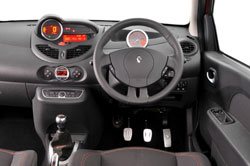
And if you are brave and experienced enough to go it alone without this safety margin, you can simply flick it off, but this option is probably best reserved for weekend race track days.
I found the RS's styling kinda cute and smart enough not to look over-the-top or too flashy, with all-new bumpers, wider, flared fenders, a cheeky spoiler and a chrome exhaust outlet combining neatly for a go-faster look.
The cabin is in tune with the athletic nature of the RS, with sport bucket seats, embossed with red Renault Sport lettering, a large rev counter, sporty aluminium pedals and racing-style, leather-trimmed steering wheel.
Luggage space is cramped but can be enlarged with seat adjustments, so it all depends on whether the priority is rear legroom or cargo space.
Being of French DNA, the RS has to have at least one quirky feature which, in this case, is strange, cheap-looking embedded bar which does duty as an outside door handle…. I cursed a couple of times as a scraped my knuckles when opening the doors.
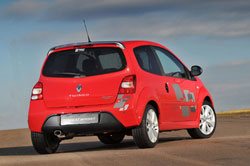
But other than that, there is much to like about the hot Twingo which, at R195,000, is the most affordable member of the Renault Sport clan.
It is precisely the type of car that will appeal to young and trendy enthusiast drivers from Venus and Mars looking for a sporty, distinctive and fairly exclusive set of wheels.
The Twingo RS's purchase price includes a three-year/45,000km service plan as well as a free advanced driver training course in the safe environment of a race track, hosted by the Renault Driver Academy
For more information on the Renault Driver Academy, visit: www.renaultsportsa.co.za.
More by Henrie Geyser: motoring editor
- Ford B-Max in a class if its own - 17 Aug 2015
- Kia's people-carrier goes all swanky - 6 Aug 2015
- RS is a sporty, comfortable commuter - 1 Jun 2015
- Cross-over Kia is a real cheerful Soul - 25 May 2015
- Stylish Renault set to Captur the market - 18 May 2015



About Henrie Geyser
Henrie Geyser joined the online publishing industry through iafrica.com, where he worked for five years as news editor and editor. He now freelances for a variety of print and online publications, on the subjects of cars, food, and travel, among others; and is a member of the South African Guild of Motoring Journalists. moc.acirfai@geirneh