


Trending


Subscribe & Follow
Advertise your job vacancies
Jobs
- News Reporter Cape Town
- Creative Strategist Johannesburg
- Account Manager Johannesburg
- Learning Technologist Durbanville
- Maintenance Engineer East Rand
- Cosmetic Manufacturer / Compounder Cape Town
- Motion Designer Johannesburg
- Communication Intern Westville
- Camera Gear Store Rental Tech Cape Town
- Internal Sales Administrator Vaal
Suzuki makes a come-back
One has to wonder about the audacity of a new car brand entering the South African market which is already over supplied, at a time when new car sales are plummeting every month, interest rates are sky-high, fuel prices are soaring and cheap Chinese cars are flooding local sales rooms.
19 Jun 2008

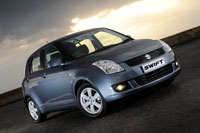
All of this obviously hasn't deterred Japanese manufacturer Suzuki who has ploughed more than R103-million into infrastructure in this country to bring back its cars after an absence of several years.
Like Honda, Suzuki is a leading Japanese brand, famous not only for cars but also for motorbikes and boat engines and they are optimistic that the company's reputation for reliability, build quality, motor-sport prowess and competitive pricing is strong enough to establish a foothold in what has become an extremely competitive market.
Suzuki South Africa's marketing and communications chief Charl Timms agrees that times are tough, but he believes that the timing is right because South African motorists are now focusing sharply on value for money cars.
Suzuki is initially introducing two models, the Swift hatchback and a C segment SX4 crossover.
The cute little Swift is rated highly in Europe for its perky 1.5-litre engine and is regarded by many as an ideal commuter and city car.
Though nowhere near hot hatch class, the Swift is nippy enough, churning out 74kW and 133Nm. Peak performances are at fairly high revs and at our launch drive the engine sounded as though it was working quite hard, but Suzuki says that's the nature of the little beast.
It certainly sits well on the road and thanks to its light body and wheels that are positioned at the four corners it handles better than most entry-level pikkies.
The Swift will be available in three model options, all powered by the same 1.5-litre engine and even the entry level GL comes with two airbags, ABS brakes with Electric Brakeforce Distribution (EBD), Brake Assist, power steering, aircon, electric windows, a satellite-tracking system, and a four-star Euro-Ncap safety rating.
The GL comes with five-speed manual transmission, and the higher-specced GLS is available with the same five-speed box or a four-speed automatic and it also has extras such as four airbags, a radio/CD player, sporty alloy wheels and a multi-function steering wheel.
Suzuki claims a 10 second 0-100km/h time for the manual and 11.7 seconds for the auto and a fuel consumption of between 6.1 and 6.5l/100km.
The SX4 is a toned down version of the vehicle Suzuki competes with in Junior Rally events. Although it's not a serious off-roader it should be quite capable of handling mild off-road conditions with ease.
Overseas it is available in all-drive format (hence the name, S for Sporty, X for crossover and the 4 for four-wheel drive), but the locally available manual and auto versions are both only two-wheel drive.
The SX4 is pushed along by a 2.0-litre fuel-injected four cylinder that produces 107kW and 184Nm, with maximum torque kicking in at 3,500rpm.
The manufacturer claims a top speed of 184km/h, fuel consumption between 8.4L and 9.5L/100km and a sprint time of zero to 100km/h in 9.4 seconds.
Like the swift, the SX5 comes with impressive specifications, it looks good, handles well and is keenly priced.
Although plastic abounds in the cockpit, both the Swift and SX4 feel solid and well-built.
We drove both vehicles very briefly - a 30km stint behind the wheel on a motorway in Gauteng is hardly the place to form a solid opinion of any vehicle - and unfortunately I did not get to drive either of the models with manual transmission.
The automatic transmission on both vehicles were not impressive, particularly when they went into hunting mode, searching for gears, between 110km/h and 120km/h, which is sure to irritate the heebie-jeebies out of drivers who have to suffer the daily ritual of clogged Reef traffic.
Of the two vehicles I much preferred the smaller-engined Swift. It felt livelier than the SX4 although, in fairness, the cars were all spanking new and Jozi's power-sapping high altitude wasn't doing it any favours.
Hopefully Suzuki will provide me with test vehicles in due course so that I can experience the manual shift (rated above average by other motoring journalists on the launch drive) and get to spend more driving time with both models.
Suzuki is certainly not in for an easy ride onto the motorways of this country and will have to work hard to entice buyers away from well-established and respected names in the business.
A big plus in Suzuki's favour is that their selling prices include a four-year/60,000km service plan for the Swift and a six-year/90,000km service plan for SX4, a three-year/100,000km warranty, AA road assistance, a six-year anti-corrosion cover and a tracking service on subscription.
The models and prices are: The Swift 1.5 GL (R116,900), Swift GLS manual (R131,900), Swift GLS Automatic (R144,900), SX4 manual (R163,900) and the SX4 Auto (R176,900).
Suzuki's performance track record
Motorsport improves the breed, the saying goes, and Suzuki Motor Corporation has consistently used motor racing as a high-profile and punishing test bed for its product range and its advanced technology.
The brand has enjoyed a long and proud association with competitive action in various forms. Its first victory came at the 1962 Isle of Man TT motorcycle race where it claimed the 50cc category win.
From then on, Suzuki's traditional blue, red and white corporate colours have signalled victory and glory around the world - both on two and four wheels and motorsport has become very much a part of the Suzuki culture.
Suzuki's recent exploits on the international motor racing stage have been headlined by its exceptional success in the Junior World Rally Championship (J-WRC), and its decision to take on the arduous and thrilling World Rally Championship (WRC) in 2008.
The basis for the WRC engagement this year lies in the phenomenal success achieved in the J-WRC since entering the sport in 2002.
Scandinavian driver Per-Gunnar Andersson first took Suzuki to the junior category title in 2004 with the Ignis Super 1600. The arrival of the Swift in 2006 produced second and third-placed finishes for the factory entries in their first complete competitive season.
J-WRC championship glory followed in 2007 for the Suzuki Swift, and made Andersson the only driver to notch up two titles in this fiercely contested series. Team-mate Urmo Aava finished in the runner-up spot.
The Swift Sport continues its J-WRC title defence in 2008 with two talented young drivers: Estonian Jaan Molder and Pole Michal Kosciuszko.
With such a winning pedigree, it's not surprising that the Swift dominates the Group N rally categories across Europe. It is equally successful at national championship level - both in rallying and circuit racing - and has done much to further the youthful image of the brand.
However, Suzuki has had its sights set on the action-packed premier World Rally Championship for some time. At the Geneva Motor Show in 2006, Suzuki Motor Company announced that a full campaign in WRC was on the cards for 2008, with the pioneering SX4 the model of choice.
A prototype SX4 World Rally Car was extensively tested on gravel and asphalt throughout Japan and Europe leading up to its two trial runs under competitive conditions in 2007 at the Rally de France in October, and the season finale at Wales Rally GB at the end of the year.
A driven and competitive philosophy is evident throughout the Suzuki Sport organisation, as even the division's president, Nobuhiro 'Monster' Tajima, has a long association with motorsport, and was responsible for a significant portion of the early development and testing of the rally car.
In addition, Tajima last year drove a 1,000hp (746kW) Suzuki Sport XL7 Special to a record-breaking time of 10 min 01,4 sec on the famous Pike Peak Hill Climb in the US. This year, the aim is to break the 10 minute barrier!
Suzuki Sport made its official WRC debut at the dramatic Rallye Monte Carlo in January 2008, with the two mighty 2,0-litre turbocharged four-wheel drive SX4 entries being driven by PG Andersson and Finn Toni Gardemeister.
During the initial phase of the 2008 season, both drivers have already scored valuable championship points.
Andersson picked up the team's first WRC point after ending an impressive eighth at the Monte Carlo season opener. Gardemeister backed this up with a seventh place at the second round in Sweden.
Both results are remarkable feats considering the exceptionally tough nature of the sport and the level of ongoing R&D required. The team is confident of surprising the established outfits in the WRC this year, and in the seasons to come.
More by Henrie Geyser: motoring editor
- Ford B-Max in a class if its own - 17 Aug 2015
- Kia's people-carrier goes all swanky - 6 Aug 2015
- RS is a sporty, comfortable commuter - 1 Jun 2015
- Cross-over Kia is a real cheerful Soul - 25 May 2015
- Stylish Renault set to Captur the market - 18 May 2015


About Henrie Geyser
Henrie Geyser joined the online publishing industry through iafrica.com, where he worked for five years as news editor and editor. He now freelances for a variety of print and online publications, on the subjects of cars, food, and travel, among others; and is a member of the South African Guild of Motoring Journalists. moc.acirfai@geirneh