Subscribe

free to biz newsletters

Bizcommunity.com - Daily Lifestyle news
Theatre newsPress offices

Profile and articles

All the dance talent at the Baxter

10 Sep 2009 15:454 commentsBizLike
The fifth Baxter Dance Festival got off to a rousing start last night, featuring a wealth of talent from Cape Town and Namaqualand. The Baxter Theatre was packed with dance aficionados, who gave due appreciation for the performers and choreographers making the most of this annual platform for their skill.
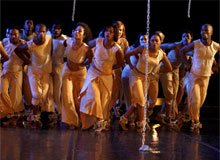
Dawn Langdown's Ek is, wie ek is linking into Jackie Manyaapelo's untitled work presented recently during Jazzart Dance Theatre's Danscape season, and choreographed on Ilse Carroll with Jazzart's Young Adult Training and Job Creation Programme trainees, was a fitting beginning to an incredible first half. Carroll's Khoisan dialogue is fascinating as she weaves through floor-to-ceiling lengths of neon LED strip lighting and steel chain while she reflects on her origins. “Die lyf kom al 'n lang pad … ”

She relinquishes the stage to the trainees and the music of Thongo (Iyeza) by Thandiswa Mazwai. This, combined with dramatic lighting and challenging, imaginative choreography that shows just how much this young group has to offer, was even better on second viewing.

Debbie Turner's Gladius, choreographed on the Cape Dance Company, is further testimony to the importance of classical training as the basis for any other dance style. The opening soloist displayed phenomenal core strength to execute some really difficult movements. The Cape Dance Company is known for its distinctly athletic repertoire and this was no exception - this was a strong performance by a well-trained group, albeit to an excruciatingly loud soundtrack that at times resembled nails being dragged across a blackboard!

Carolyn Holden's flamenco solo choreographed on Peter Agulhas was a refreshing showcase of this genre. Enacting the emotional state of a man imprisoned by his own mind, and his struggle for freedom, Agulhas's clean footwork and dramatic interpretation were enhanced by live musical accompaniment by Holden, Robert Davids (percussionist), Lorean Swartz (vocalist) and Bienyameen (guitarist).

Up the Down Stairs, by Ebrahim Medell for the Eoan Group, was energetic, quirky, well performed and cleverly staged, using a covered ramp along the back as a prop. The audience also loved Dawn Langdown's Is; Was; Sal Wees, performed by Namjive from Namaqualand. They caught the humour in the dialogue about identity and applauded the distinctive cultural elements of the choreography.

The biggest disappointment of the evening was the Festival's commissioned piece, the very long Mendi, choreographed by Mamela Nyamza and enacted by Jazzart trainees. There was very little dance. While Mendi might have its place on a stage somewhere, it was the wrong item to end a lengthy programme and certainly is not the type of thing I expect to see at a dance showcase.

The festival stages different programmes daily until 12 September, with a fringe programme on 13 September. Tickets for 8pm shows are R65 and R20 for Sunday's programme at 2pm. For more information, go to www.baxter.co.za.
 
More options
< Back

About Debbie Hathway

Debbie Hathway is a specialist dance writer and critic for the Cape Times as well as Bizcommunity's BizLounge. She was a writer, columnist and critic for the Weekend Argus, Cape Argus and Daily News Tonight.View profile and articles...
Vuyelwa
Mendi-
It was one of the Interesting movement pieces the festival has ever had. Movement is dance its more harder than dance steps-,Which Cape Town dance scene is still stuck with the past dance steps that we have seen throughout the years. The only thing that is changing is the costume and the title its like doing class on stage. Mendi was theatrical, dramatic, thought provoking, cutting edge... it challenged the audience. it has moved on with times and it is dance theatre and contemporary art, which is where dance/movement is at the moment. The movement used depicted people drowning under the sea... which suited the story of The Sinking of Mendi where 812 black men sank and died on icy water on their way to France during World War 1 (1914-1918). Cape Town is so behind with the whole spectrum of dance. A black female choreographer brings work that is rich, ritual, healing and interacting with the people and you call it a thing because you did not do your research about Mendi. Posted on 14 Sep 2009 10:11
Dance theatre-
If space allowed, I would have elaborated more on my opinion of Mendi. Let me be clearer now: The performances given were admirable; the dramatic theatre elements highly impactful; the music selection, as always, phenomenal. The choreographer and cast are such talented dancers, it was disappointing not to see them display those skills on stage in this piece. Those who could not understand the narrative lost the nuances of the script, which limited appreciation for the equally limited movements on stage. A man (a non-dancer) who knew the language said it's the best thing he's ever seen. Another man (a dancer) who couldn't understand the language but understood the context appreciated the intention but still felt there was not enough dance and that it was too long. Everybody has a different opinion. I felt that it's the kind of piece that should have been performed alone so that it's length and time of showing would not detract from its overall impact. Posted on 21 Sep 2009 12:08
Hans van Niekerk
commenting on Debbie Hathaway regarding mendi-
Dear Debbie Hathaway....on the subject of dissapointment:
I am so sad and disappointed that the discourse on contemporary dance in this country and particularly Cape Town is so ignorant and lacks intelligence and research.
My first point would be to question what exactly you would refer to as contemporary dance? The meaning of contemporary is the 'now' and not the past...surely we need to see some evolution in dance to be able to use the term contemporary?
Struggling to follow your train of thought regarding the work at Baxter, it seems to me that your understanding is far from contemporary. And your disappointment with the work Mendi stems from the fact that it does not fit into your box of what dance is, or is not.
Furthermore, our context would be that of African contemporary, meaning that we are dealing with artists and performers with a local history...thus I would question your reference to your high regard of.'classical training'. Not to say that classical training is not beneficial, though bearing in mind this refers to a non-african context.
If one looks at our most outstanding contemporary dance makers from this country and continent: Robyn Orlin, Vincent Mantsoe, Boyzie Cekwana, Nelisiwe Xaba, Sello Pesa, Nora Chipumera and countless others,sadly and with deep regret they are no longer working in this country yet highly regarded on international platforms. I attribute this very sad loss to the inability of people such as yourself who it seems are unable to extend themselves to understand mature, intelligent, CONTEMPORARY work.
Thank goodness for journalists such as Adrienne Sichel who are truly contemporary in their reflections and able to give constructive critique, unfortunately she is based in Johannesburg. Posted on 14 Sep 2009 12:15
Dear Hans-
Thank you for your comments. As a dance writer and critic of many years standing, there are three things I take into account when writing an article for publication - the audience (current and potential); the people responsible for the performance (cast and choreographers); and the promotion of the art form to get "bums on seats". My mentor, the late arts editor Sjoerd Meijer, taught me that if an arts writer didn't have anything nice to say, he/she should write around it for the sake of encouraging continued support of the arts. It's a philosphy I have always applied.
In that light, choreographers and dance companies who want to challenge local audiences should do so by all means - while doing everything possible to sustain financial support - without it, they can't and don't survive. They need to find a balance between growing new, younger audiences and entertaining their loyal following - developing new audiences takes time. Look how long it's taken Jazzart Dance Theatre...
Capetonians are fortunate to have so many art forms and theatre venues on their doorstep - and producers have so much talent to work with. I know many of the choreographers personally who you have referred to in your notes and also miss seeing their work. The Eoan Group's piece was particularly reminiscent of Robyn Orlin's style. I was privileged to be able to see many of her, and other local and international luminaries, make work on the then Napac Dance Company when formal arts budgets still existed.
My preceding reply to Vuyelwa provides more insight to my opinion. Posted on 21 Sep 2009 12:39
LEGAL DISCLAIMER: This Message Board accepts no liability of legal consequences that arise from the Message Boards (e.g. libel, slander, or other such crimes). All posted messages are the sole property of their respective authors. The maintainer does retain the right to remove any message posts for whatever reasons. People that post messages to this forum are not to libel/slander nor in any other way depict a company, entity, individual(s), or service in a false light; should they do so, the legal consequences are theirs alone. Bizcommunity.com will disclose authors' IP addresses to authorities if compelled to do so by a court of law.
Follow us:

Community activity

  • Jana van Heerden Writer at Whats on in Cape Town created a profile
    1 days, 16 hours, 38 minutes ago
  • Magdalena Zukowski
    Prepping for the big bang launch of SACoaching.com Watch this space
    4 days, 7 hours, 21 minutes ago


Subscribe

Receive free email newsletter

Make us your homepageAdd us to your favoritesRSS feedGet biz on your phone

Invite

Tell a friend about us