South Africa's education system cannot become more inclusive without confronting the role language plays in shaping identity, belonging and learning. That was the central message from St Benedict's College's annual Embrace Symposium, where educators gathered to explore how African knowledge systems and cultural identity can shape a more inclusive education system.
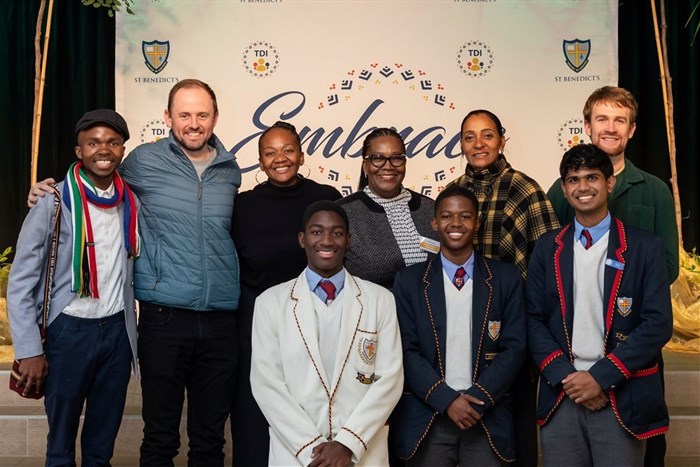
Source: Supplied
For admitted attorney and teacher Chris Harrison, the conversation starts with language. It is not simply how people communicate, he argues, but how they think, who they are and what they are able to imagine.
Every word a child speaks carries more than meaning. It carries culture, identity, history, and a particular way of understanding the world.
When that language is slowly eroded, replaced by another that carries different assumptions and different values, something is lost that no curriculum review can recover. This was the argument Harrison brought to the St Benedict's College Embrace Symposium this Youth Month, and it landed with quiet force in a room of educators already wrestling with what it means to truly serve every child in their care.
Now in its established run as one of Johannesburg's most important annual gatherings for educators, the Embrace Symposium has built a reputation for bringing difficult, necessary conversations into the open.
This year, teachers and school leaders united around a theme that St Benedict's identified as increasingly urgent: Using Indigenous Knowledge Systems and Pedagogies as Pathways to Social Healing in Education.
The choice of theme was deliberate. South Africa is a deeply African society, yet much of what happens inside schools, from dress codes to curricula to the cultural traditions that define school life, reflects very little of that. Language sits at the heart of that gap. It is both the symptom and the cause, and it was Harrison's task to name it plainly.

Source: Supplied
The programme was structured as a journey rather than a lecture series. It opened with a musical performance by Asakhe Cuntsulana, a deliberate choice rooted in the understanding that music is a universal language and that healing, more often than not, begins with connection and emotion rather than theory.
In the South African context, music has long been a vehicle for preserving indigenous knowledge, expressing identity, and building community. From that shared emotional space, the symposium moved into conversations about language, identity, and ultimately, transformation.
The breakout sessions that followed offered a glimpse of something parents seldom get to see: the behind-the-scenes commitment of educators who are the real custodians of their children's futures.
Delegates debated, challenged each other, and pushed for change rooted in the conviction that every child, regardless of background, language, or identity, should walk into school and feel they belong there.
The language you speak shapes the world you see
Harrison, an admitted attorney and teacher with a longstanding interest in South African multilingualism, anchored his presentation in the Sapir-Whorf hypothesis, a linguistic theory that holds that the language you speak shapes not just how you communicate but how you think and understand the world.
In practical terms, when a child loses their home language, they lose more than words. They lose a way of knowing. As philosopher Ludwig Wittgenstein put it: "The limits of my language are the limits of my world."
Harrison's own journey into this question began personally. Following his experience of learning Setswana as an adult, he has spent years researching the most effective ways to teach South African languages and the role they play in how people access opportunity, build relationships, and make sense of their lives.
What he found challenges some of the assumptions that sit quietly at the heart of South African private and former Model C school culture.
African languages, he argues, are not a disadvantage to be overcome. They are an asset being systematically undervalued. And the cost of that undervaluation is being paid by children.
When children lose their home language
The trend Harrison described is growing in schools. Parents who speak African languages are increasingly choosing to speak only English at home, often with limited fluency in it.
The motivation is understandable: English is seen as the language of opportunity, of professional advancement, of the schools their children attend. But the result is children who develop what Harrison called a "very thin, limited home language," without a strong foundation in any language at all. The consequences show up across every subject, and the developmental years lost cannot be recovered.

Source: Supplied | Embrace Symposium speaker Chris Harrison
He described a parent who insisted her child speak English with a "coconut accent," convinced it would open doors. That same parent ran a thriving business conducted almost entirely in SiSwati, using her home language to win government contracts and build lasting relationships. The irony is instructive.
Real access, in real South Africa, happens in African languages every day. In settings like healthcare, the overwhelming majority of interactions take place in African languages. Schools that unconsciously teach children to be ashamed of those languages are not preparing them for the country they will actually live in.
The point is not that English does not matter. It does. But, as Harrison argued, mother-tongue education and the teaching of African languages is not in competition with English fluency. It is the foundation that makes genuine fluency in any language possible.
Why language diversity matters
Harrison's broader argument was one of convergence. If the language you speak shapes how you think, then a generation educated exclusively through English is a generation converging on a single way of seeing the world. South Africa's ability to solve its own problems, he argued, depends on people who think differently, who bring different frameworks and different knowledge systems to the table.
He suggested that, as independent schools, there is a tendency to sideline African languages, to position English as the language of knowledge and advancement. But if South Africa is to prepare young people for genuine success in this country, that position needs to be challenged. Economically, socially, and cognitively, African languages matter.
Mother-tongue education makes sense, and a school system that treats those languages as second-class is not just failing to honour its students' identities. It's narrowing their minds.
Turning discussion into action
One of the questions the symposium kept returning to was a practical one: how do teachers take what they have heard and actually make change happen when they get back to school? Executive Head of St Benedict's, Andre Oosthuysen, is clear that the process has to be driven from the top.
A head who listens, who creates space for staff to question inherited traditions, and who actively supports experimentation makes it possible for teachers to take risks. Without that executive endorsement, change stalls.

Source: Supplied
The symposium pointed to three practical anchors for making change sustainable: listening, storytelling, and community building. Creating consistent platforms where boys and staff can move beyond the comfort and insularity of their own social bubbles, where different voices are genuinely heard rather than just acknowledged, is where transformation takes root. Not in a policy update. In a conversation.
Continuing the conversation
The Embrace Symposium did not offer easy answers. That was never the point. What it offered was a room full of educators willing to sit with difficult questions and commit to carrying them back into their schools.
How do we prepare children not just with qualifications, but with the full range of who they are? How do we build schools where every language, every story, every identity is treated as an asset rather than an obstacle?
St Benedict's College is committed to creating this space year after year, choosing themes that matter and trusting that educators, given the right room and the right provocation, will do the right thing for the children in their care.
Held during Youth Month, the event carried its own message. South Africa's young people are the point. They are the reason the conversation matters.
It is educators, the ones debating mother-tongue education and the weight of inherited assumptions in breakout sessions, who are doing the quiet, essential work of building schools those young people deserve.
