
Africa gains influence as Zimbabwe wins seat on UN Security Council
Zimbabwe has secured a seat on the United Nations Security Council, giving Africa a stronger voice in a body whose decisions can have far-reaching implications for global trade, energy markets and investor sentiment.
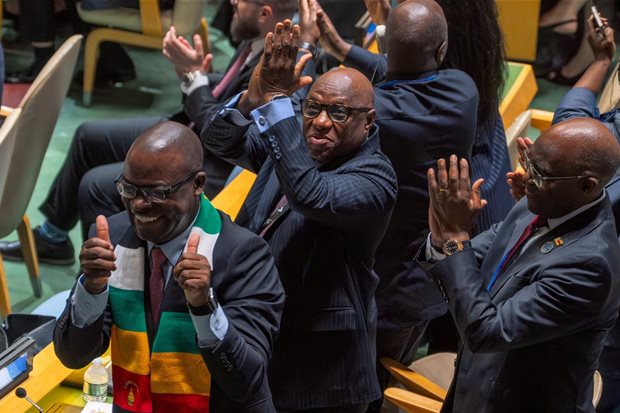
Source: Reuters/David 'Dee' Delgado. Zimbabwe's Minister of Foreign Affairs and International Trade Amon Murwira and the Zimbabwe's delegation celebrate after winning the election of non-permanent members of the United Nations Security Council at UN headquarters in New York City, US, Wednesday, 3 June 2026.
As the only UN body empowered to impose sanctions and authorise the use of force, the Security Council plays a central role in shaping international responses to conflicts that can disrupt shipping routes, influence commodity prices and affect economic stability worldwide.
The United Nations General Assembly on Wednesday, 3 June 2026 elected Zimbabwe as one of five new non-permanent members of the 15-member council for a two-year term beginning on 1 January 2027.
Zimbabwe will join Austria, Kyrgyzstan, Portugal, and Trinidad and Tobago as newly elected members. The southern African nation will replace Somalia, whose term concludes at the end of 2026.
A seat matters
The Security Council is the only UN body empowered to make legally binding decisions, including imposing sanctions and authorising the use of force. While the council's five permanent members – Britain, China, France, Russia and the United States – retain veto powers, elected members play a significant role in shaping debates, advancing regional priorities and influencing international responses to conflicts and crises.
Zimbabwe's election comes as African countries continue to advocate for greater representation within global institutions. The continent currently holds three rotating seats on the council, providing opportunities for African states to raise issues affecting the region, including peace and security, development challenges and conflict resolution initiatives.
The General Assembly elected the new members according to regional allocations. Zimbabwe secured the seat designated for the Africa Group, while Trinidad and Tobago was elected for the Latin American and Caribbean Group. Austria and Portugal won the two seats allocated to the Western European and Others Group, where Germany failed in its bid despite extensive lobbying efforts. Kyrgyzstan secured the Asia-Pacific Group seat after four rounds of voting against the Philippines.
The election marks a milestone for Kyrgyzstan, which will serve on the Security Council for the first time.
The incoming members will join Bahrain, Colombia, the Democratic Republic of Congo, Latvia and Liberia, which will continue serving on the council through the end of 2027.
The newly elected countries will assume their seats at a time when geopolitical tensions, regional conflicts and questions around international security continue to dominate the global agenda, giving Africa an important platform from which to contribute to discussions shaping international peace and stability.